

Therapy for OCD
 When your mind won’t let it go.
You’ve replayed the conversation a dozen times, but you’re still questioning whether you said something wrong.
You know you locked the door, but the thought that you might not have keeps pulling you back.
You find yourself searching for reassurance, questioning your feelings, or mentally reviewing situations, hoping to finally feel certain.
And even when you find an answer, the relief doesn’t seem to last.
It’s exhausting when your mind keeps asking questions that never seem to have a satisfying answer.
For some people, these patterns are more than everyday anxiety or overthinking. They may be signs of Obsessive-Compulsive Disorder (OCD). At Red Cedar Therapy, we provide specialized OCD therapy in Smyrna, Tennessee, helping children, teens, and adults understand these patterns, respond differently to intrusive thoughts, and begin reclaiming time and energy from OCD.
OCD isn’t always what you think it is.
When most people hear “OCD,” they picture excessive handwashing, organizing, or checking things repeatedly. But OCD can look very different from person to person. Obsessive-Compulsive Disorder involves unwanted, recurring thoughts, images, feelings, or urges that create distress or uncertainty. These experiences are called obsessions. To reduce that discomfort, a person may engage in repetitive behaviors or mental rituals, known as compulsions. Sometimes compulsions are visible. Other times, they’re happening entirely inside someone’s mind.
OCD may show up as:
-
Intrusive thoughts: Unwanted, disturbing thoughts or images that seem to appear out of nowhere.
-
Constant reassurance-seeking: Repeatedly asking others for confirmation that everything is okay.
-
Mental reviewing: Replaying conversations, memories, or decisions to make sure nothing was missed.
-
Checking behaviors: Repeatedly checking locks, appliances, messages, assignments, or other details.
-
Contamination fears: Feeling overwhelmed by concerns about germs, illness, or exposure.
-
Perfectionism and “just right” feelings: Repeating or adjusting things until they feel exactly right.
-
Relationship OCD: Repeatedly questioning your feelings, your partner, or the certainty of your relationship.
-
Fear of making mistakes: Feeling consumed by the possibility of doing something wrong or causing harm.
OCD isn’t a personality trait or simply a preference for organization. It can interfere with relationships, school, work, and everyday routines.
And while the content of obsessive thoughts can feel frightening or embarrassing, having an unwanted thought doesn’t mean you want it to happen or that it reflects who you are.
The cycle that keeps OCD going
OCD often creates a repeating pattern that can feel difficult to escape.
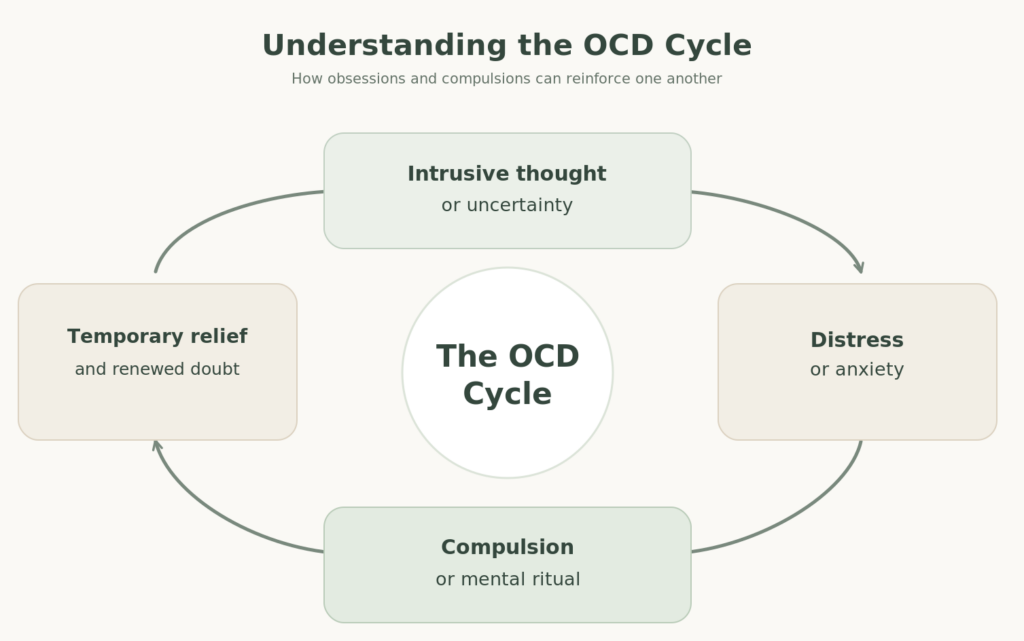
Compulsions may provide temporary relief, but they can reinforce the cycle over time.
The difficult part is that compulsions often work temporarily.
Checking, asking for reassurance, avoiding situations, or mentally reviewing what happened might ease anxiety in the moment. But over time, these behaviors can reinforce the belief that uncertainty is dangerous and must be resolved.
Treatment helps you change how you respond to uncertainty rather than continually trying to eliminate it.
How does OCD therapy work?
Exposure and Response Prevention (ERP)
At Red Cedar Therapy, Rebecca Massey has completed specialized training in Exposure and Response Prevention (ERP), a form of Cognitive Behavioral Therapy (CBT) widely recognized as a first-line psychological treatment for OCD.
ERP helps individuals gradually face the thoughts, situations, or feelings that trigger obsessive fears while learning to reduce the compulsive responses that keep the cycle going.
This doesn’t mean being thrown into overwhelming situations or being expected to face your biggest fear on day one.
Treatment is collaborative, intentional, and tailored to each person’s needs.
Together, you may work on:
-
Recognizing the difference between an intrusive thought and a genuine problem that requires action.
-
Identifying compulsions, including mental rituals that may be difficult to notice.
-
Gradually practicing responses to feared situations without relying on compulsions.
-
Building tolerance for uncertainty and uncomfortable emotions.
-
Reducing avoidance and reassurance-seeking.
-
Reconnecting with relationships, activities, and experiences that OCD has interrupted.
The goal isn’t to guarantee that you’ll never experience an unwanted thought again.
It’s to help you build a life where those thoughts no longer have to make your decisions for you.
OCD therapy for children and teens
 OCD can be especially confusing for children and teens who may struggle to explain what they’re experiencing.
Parents may notice repeated questions, excessive checking, difficulty completing homework, unusual routines, or emotional distress when something doesn’t feel right.
Sometimes what appears to be defiance, avoidance, or excessive worry may actually involve obsessive fears and compulsive behaviors.
Rebecca brings more than a decade of experience in School Counseling, along with specialized training in ERP for children and adolescents.
Her approach considers each young person’s developmental needs while helping them understand OCD and build practical skills for managing symptoms.
When appropriate, parents and caregivers may also be involved in treatment to learn how to provide support without unintentionally reinforcing OCD patterns.
Frequently Asked Questions
Is OCD the same as anxiety?
OCD and anxiety can share symptoms, but they aren’t identical. OCD specifically involves patterns of obsessions and/or compulsions. Understanding these patterns helps determine which treatment approaches may be most helpful.
Can you have OCD without visible compulsions?
Yes. Some compulsions occur internally, including mentally reviewing events, silently repeating phrases, or trying to neutralize unwanted thoughts. A person may appear calm on the outside while spending significant time engaged in mental rituals.
What if my intrusive thoughts are embarrassing or frightening?
People with OCD can experience unwanted thoughts about subjects that feel deeply uncomfortable or inconsistent with their personal values. Therapy offers a nonjudgmental setting to discuss those experiences and understand their role in OCD.
Can children and teens benefit from ERP?
Yes. ERP can be adapted for different developmental stages, and family involvement can be helpful when appropriate.
Treatment length varies depending on symptom severity, goals, individual needs, and consistency with practicing skills. Your therapist will work with you to develop a plan and assess progress along the way.
 Meet Rebecca Massey, M.Ed., Clinical Mental Health Counselor
Rebecca provides OCD therapy for children, teens, and adults at Red Cedar Therapy.
Her specialized training includes Exposure and Response Prevention (ERP), treatment of OCD in children and adolescents, and Relationship OCD.
Her approach combines warmth, curiosity, and practical skill-building, helping clients feel understood while developing tools they can apply outside the therapy room.
You deserve more than temporary relief.
You don’t have to spend your days negotiating with intrusive thoughts, second-guessing every decision, or searching for certainty that never seems to last.
Whether you’re seeking support for yourself or your child, specialized OCD therapy can help you begin responding to obsessive fears differently. At Red Cedar Therapy, we’re here to help you take that next step.
Schedule your free 15-minute consultation with Rebecca to learn more about OCD therapy in Smyrna, TN.